Introducing MusicTrends.net
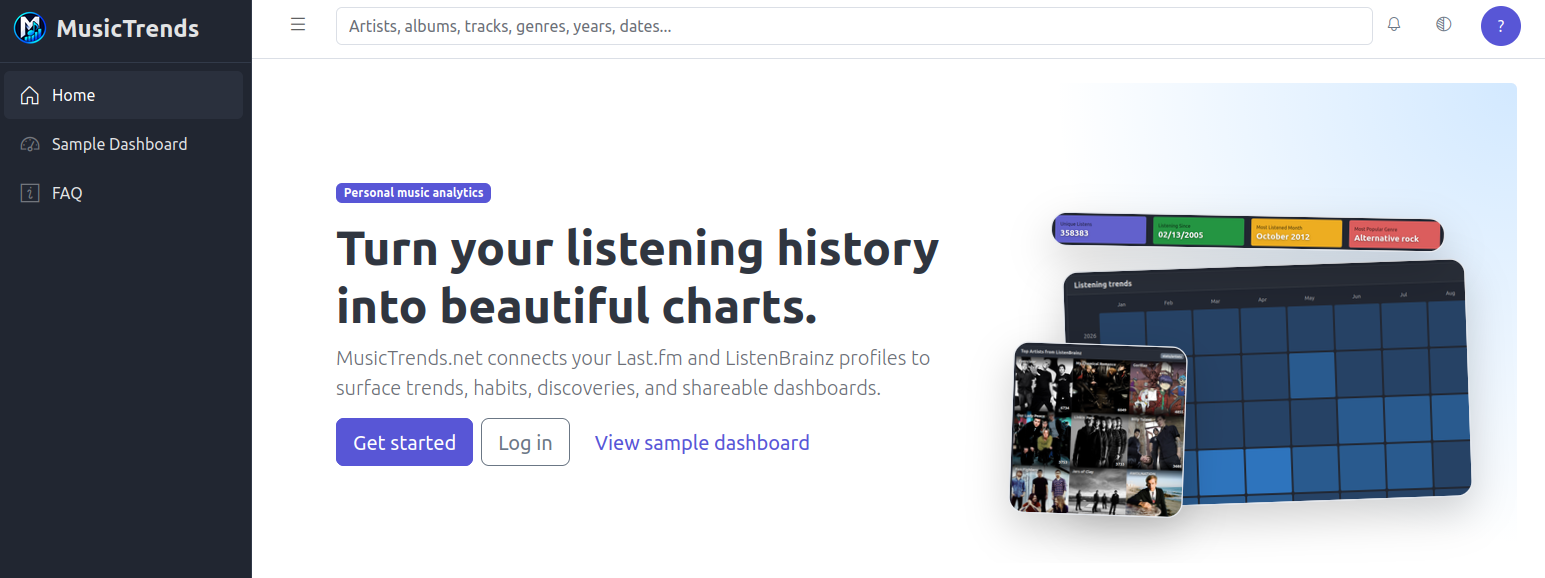
I've been tracking the music I listen to for years.
And I mean years.
Services like Last.fm and ListenBrainz have done a great job of collecting that history and giving me ways to look back at it. I can see my top artists, albums, and tracks over different periods of time, and that's always been interesting.
But I've also always wanted to ask different questions of that data.
When did I first discover an artist?
Was there a song I listened to five times and forgot about, only to rediscover it years later and suddenly play it 50 times?
When did I go through a particular musical phase—and how long did it last?
What artists or genres have slowly disappeared from my listening habits? Which ones have somehow stuck around for 20 years? Which ones have emerged and replaced those old favorites?
Those are the kinds of questions that eventually led me to build MusicTrends.net.
I wanted to see the story behind the numbers
I've always been interested in data, but the interesting part of listening history isn't necessarily knowing that Artist X was my #1 artist last year.
It's why that happened and how it fits into everything else.
For example, there was a period when I listened to a lot more electronic music. Looking at that in isolation, it simply appeared to be a change in musical taste. But it also happened to be when I was doing a lot of distance running. Suddenly those steady electronic beats made a lot more sense.
Then there are the stretches where my listening history apparently decided it was time to revisit my teenage angst.
Music has a funny way of attaching itself to whatever else is happening in our lives. Looking at years of listening history means you're not just looking at a collection of songs—you can sometimes see pieces of your own history buried in there.
That's what I wanted to explore.
So I built the thing I wanted
MusicTrends started as one of those projects that had been floating around in my head for a while.
I already had the listening data. I just wanted more ways to slice and dice it.
Instead of focusing primarily on charts of your most-played music, MusicTrends is designed around exploring how your listening changes over time: discoveries, trends, phases, outliers, old favorites resurfacing, and whatever other interesting patterns might be hiding in the data.
Some of those are things MusicTrends can surface today.
Others are very much still on my list.
And that's part of the fun.
This is very much a passion project
I should probably set expectations here: MusicTrends isn't a startup.
There's no MusicTrends office. There's no support team. There's no product organization debating the quarterly roadmap.
It's me.
I'm building it because it's something I wanted to exist, because I enjoy working with this kind of data, and because it gives me an excuse to keep experimenting with technologies and ideas outside of my day-to-day work.
That also means it probably won't always behave like a polished commercial product.
When you first sign up, for example, MusicTrends may have years—or potentially decades—of listening history to process. Gathering, enriching, and analyzing all of that while respecting the limits of the services providing the data takes some time. Some of the additional analysis, such as identifying genres, happens separately and catches up afterward.
So if you sign up and everything isn't magically there 30 seconds later, nothing is necessarily broken.
Give it a little time.
Why make it public?
The original motivation was pretty selfish: I wanted this for myself.
But I can't imagine I'm the only person who has looked at years of listening history and wondered what else is hiding in there.
Maybe you want to know when you discovered the band that eventually became your favorite.
Maybe you want to see which artists survived every change in your musical taste.
Maybe you want evidence of that inexplicable six-month ska phase.
Or maybe you'll look at the data in a completely different way and give me an idea I haven't thought of yet.
That's a big reason I'm opening MusicTrends up for other people to use.
And this is just the beginning
There are already plenty of things I want to add.
I'd like to keep finding better ways to identify meaningful changes rather than simply displaying more charts. I want to experiment with combining listening history with other data that can provide context around why those changes might have happened. And I'd like MusicTrends to surface things you weren't necessarily looking for in the first place.
Most importantly, I don't have a finished roadmap for where all of this goes.
That's intentional.
This is a project where I can build something, see whether it's interesting, throw it away if it isn't, and follow ideas that probably wouldn't survive a normal product prioritization meeting.
And now I'm curious to see what happens when other people's listening histories get thrown at it.
So, after spending a lot of nights and weekends building, debugging, processing a frankly ridiculous amount of music data, and inevitably finding a few more things I want to change...
MusicTrends.net is live.
Give it a try at MusicTrends.net.
And if you find something interesting in your listening history—or have an idea for something MusicTrends should help you discover—I'd love to hear about it.

Comments ()